The value creation math has changed
For a decade, private equity returns leaned on things outside a portfolio company's four walls. McKinsey’s 2026 Global Private Markets Report estimates that multiple expansion and cheap leverage accounted for 59 percent of returns between 2010 and 2022. Neither is coming back on schedule.
Bain’s Global Private Equity Report 2026 puts the consequence plainly: generating attractive returns now requires significantly more operational improvement and revenue growth. Typical deals need around 10 to 12 percent average annual EBITDA growth to hit a 2.5x return, and holding periods at exit hover around seven years. Sponsors have noticed: McKinsey reports firms have more than doubled the size of their operating groups since 2021.
So the question for an operating partner is no longer whether to pull operational levers. It is which ones move EBITDA fastest in a company with no IT department, a few key people holding everything in their heads, and a business that runs on spreadsheets.
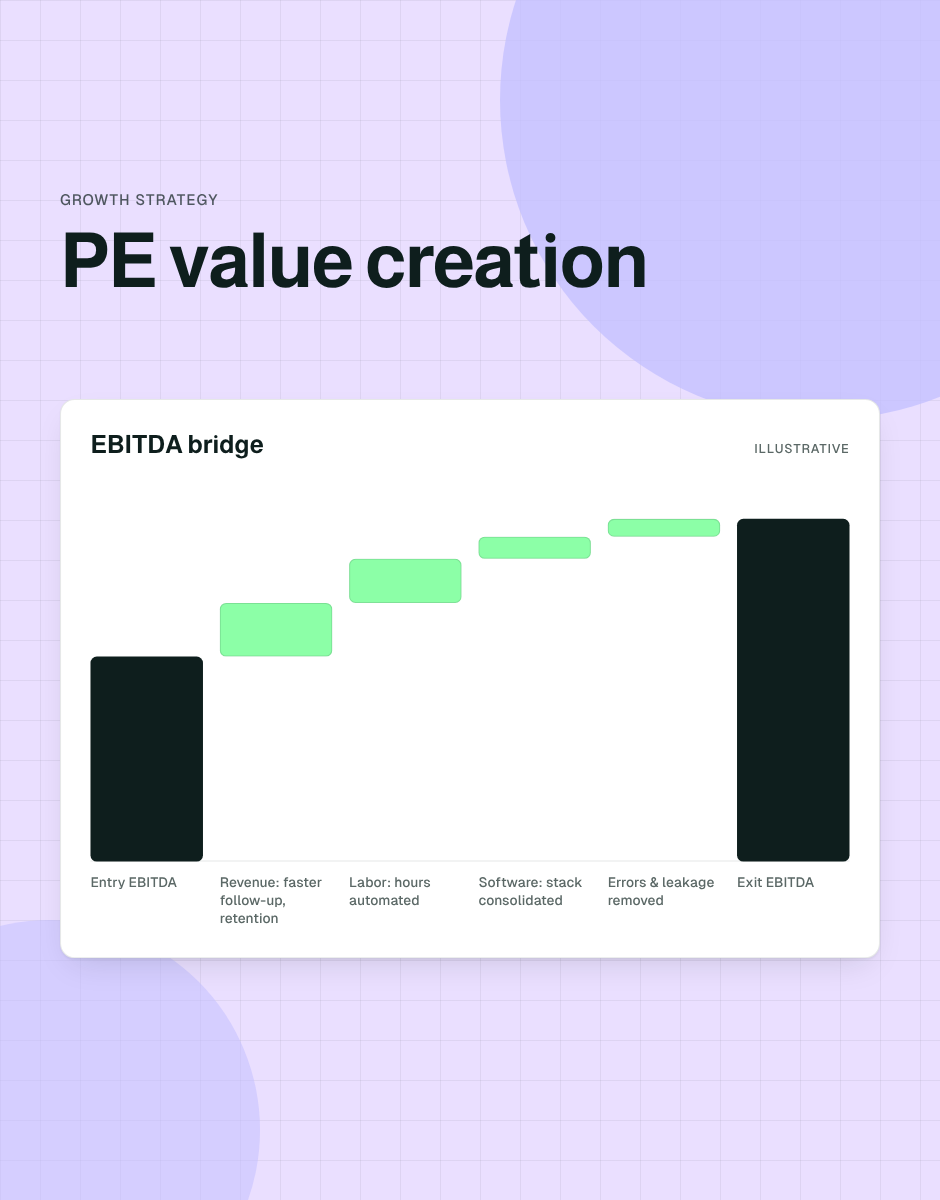
Four places technology moves EBITDA
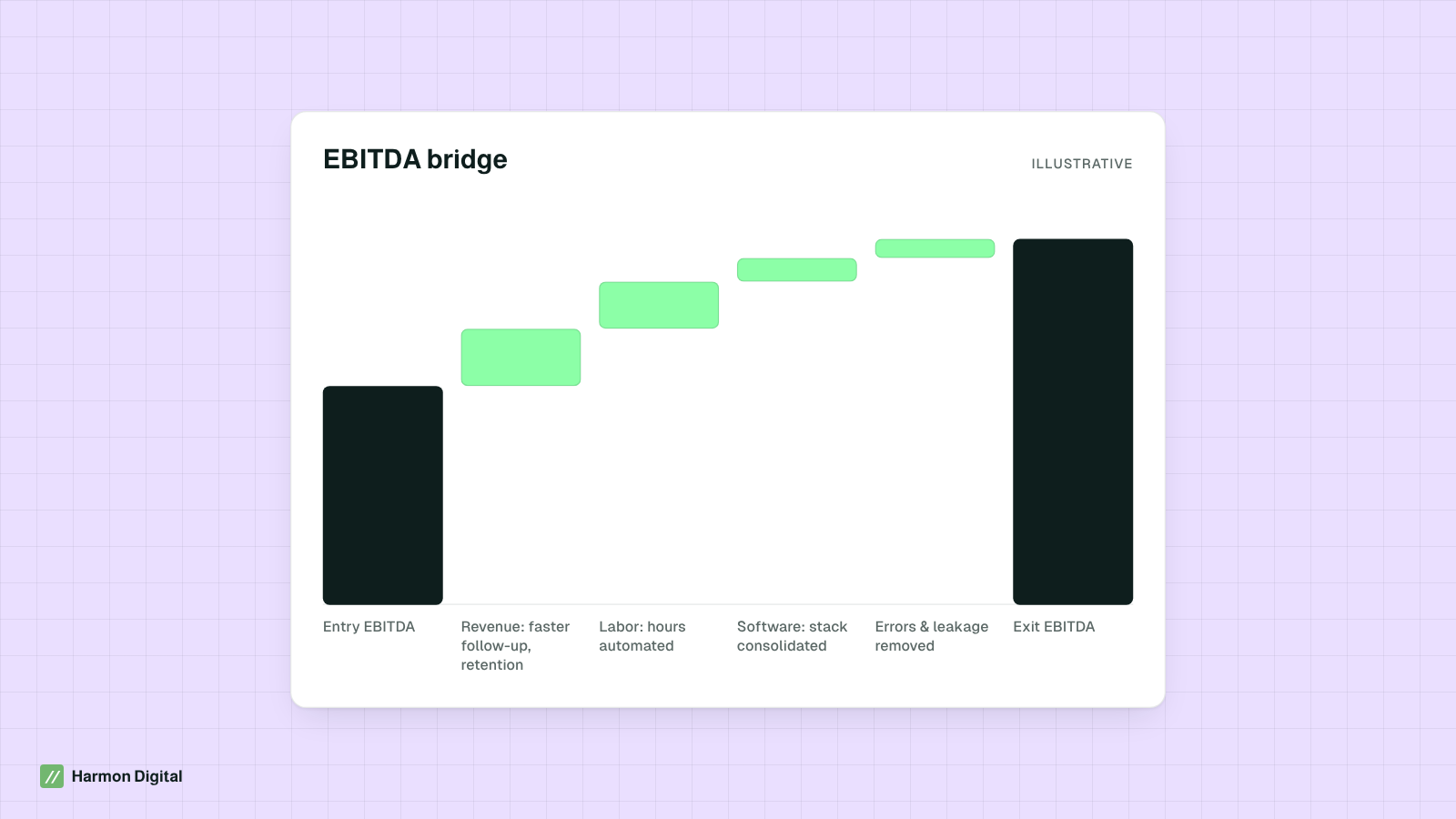
1. Revenue: answer faster, follow up always
The fastest revenue in most service businesses is in the leads and quotes they already have. Responding in minutes instead of hours, and following up every quote automatically, converts more of the demand you have already paid for. We've written a full guide to speed to lead.
2. Labor capacity: automate the hours, not the people
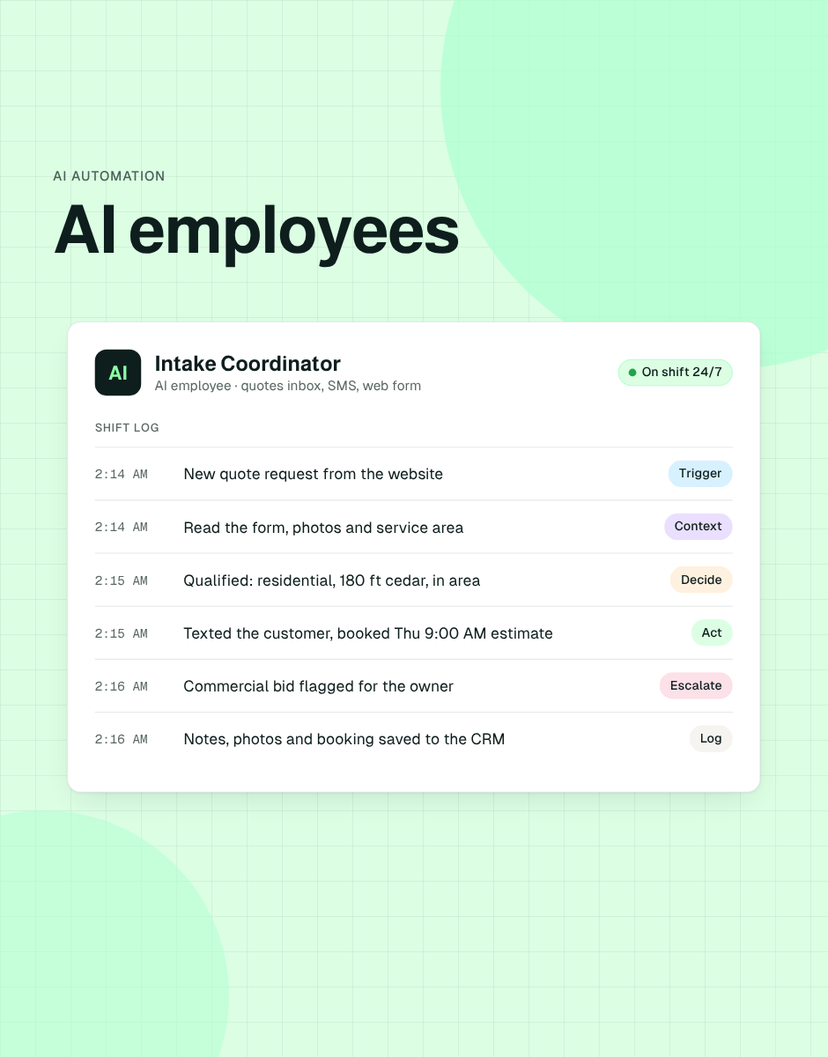
Every company has people spending hours a week re-keying data between systems, chasing approvals and building reports by hand. ProducifyX, a recruiting firm we work with, ran hiring across eight separate tools; we replaced them with one platform that handles applicant tracking, video interviews, e-signatures and client approvals in one place. AI employees extend the same idea to work that needs reading and judgment.
3. Software spend: consolidate the stack
Founder-led companies accumulate tools. Many overlap, some are barely used, and none of them talk to each other. Happy Endings, a London ice cream maker, is moving its ordering, production records, recall tracing and staff training onto one owned platform instead of a stack of separate subscriptions.
4. Leakage: errors, lost orders and rework
Bad data is expensive in ways that rarely show up as a line item. Gartner estimates poor data quality costs organizations an average of $12.9 million a year, and decades of spreadsheet research concludes that spreadsheet errors are both common and non-trivial. Lost orders, wrong prices, missed invoices and inventory that doesn't match the shelf are margin leaking out quietly.
Why the lower middle market needs a different playbook
Large-cap value creation playbooks assume a CIO, an ERP and an integration budget. A $5–50M revenue company usually has none of those. What it has instead:
- Spreadsheets as the system of record, maintained by one or two people who are now key-person risks.
- Off-the-shelf tools bought one at a time, each solving one problem and creating a new data silo.
- Add-on acquisitions on different software, so the platform cannot see the combined business.
- No in-house technical team to run a two-year ERP implementation, even if one made sense.
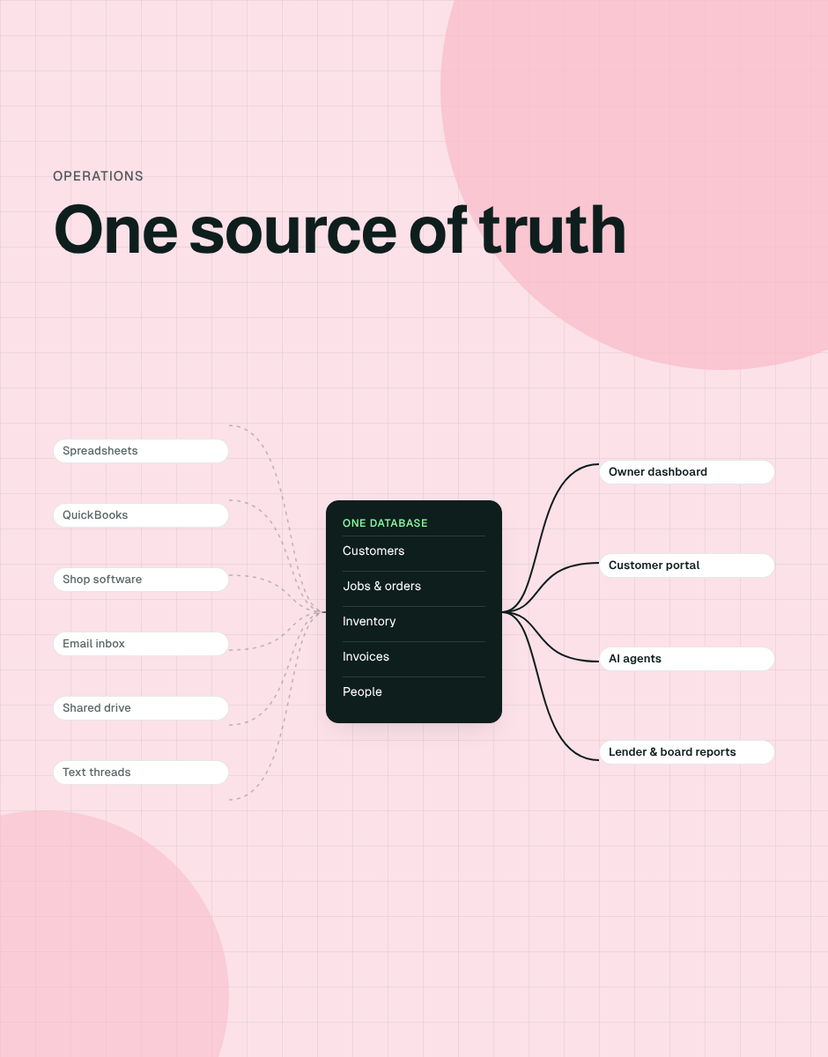
That is why the highest-return projects are usually focused, owned systems built in weeks, not enterprise programs measured in years. We explain the build-versus-buy decision in our guide to creating a single source of truth.
A technology value creation plan, phase by phase
| Phase | Timing | What happens | Output |
|---|---|---|---|
| Diagnose | Weeks 1–4 | Systems audit: stack, manual hours, data flows, risks | Costed opportunity list |
| Quick wins | Days 30–90 | Speed to lead, quote follow-up, invoice and report automation | EBITDA impact inside the first two quarters |
| Foundation | Months 2–6 | One source of truth for customers, jobs, inventory and money | Reliable weekly KPIs |
| Scale | Months 4–12 | AI employees on high-volume roles; add-ons onboarded onto the platform | Capacity without matching headcount |
| Exit-ready | Ongoing | Documented workflows, owned software, clean reporting history | A cleaner diligence story |
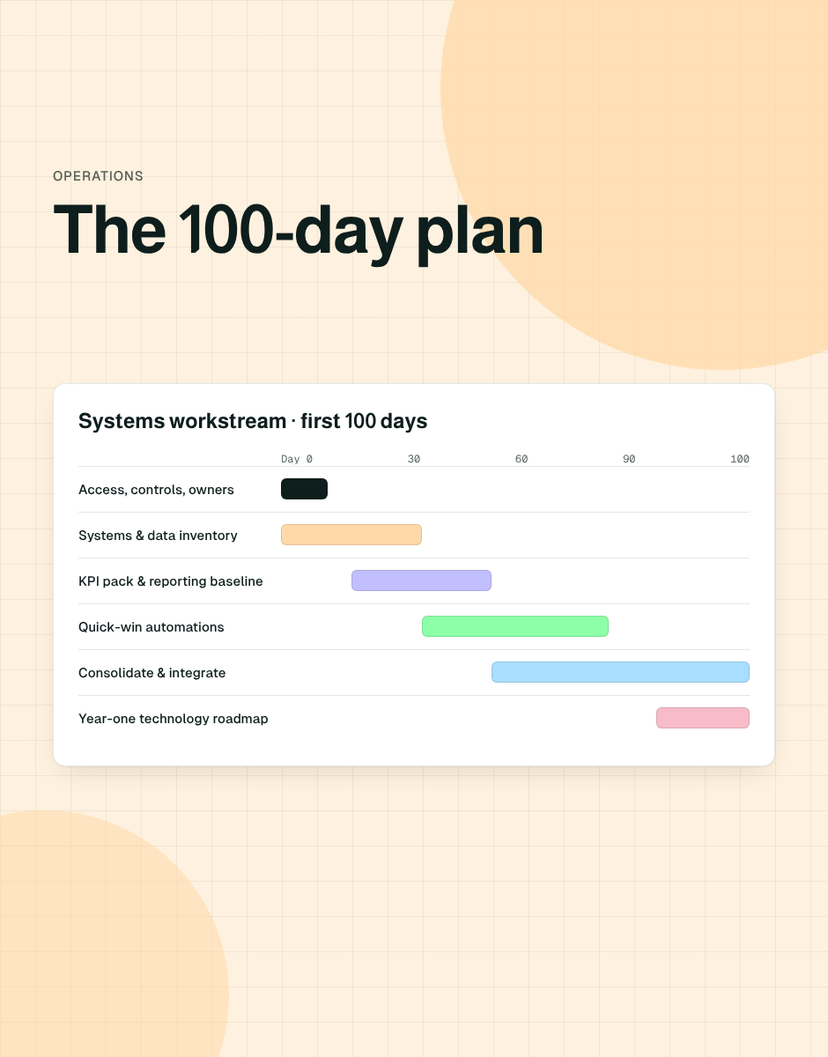
If you're early in the hold, start with the 100-day plan for systems, which covers the first steps in order.
Where AI fits in value creation
AI is now a value creation lever in its own right, not just a productivity tool. McKinsey’s research on how AI creates value in private equity ties AI maturity to valuation, reporting that companies advancing from level three to level four of its maturity scale saw an 11-point increase in median revenue multiples.
In the lower middle market, that starts small and specific: one AI employee owning lead intake, one answering internal questions, one capturing orders from email. Each is measurable, and each makes the company less dependent on a single person's memory, which is exactly what a buyer wants to see.
Questions to ask before funding a technology project
- Which EBITDA line does this move, and how will we measure it in 90 days?
- Is this replacing manual work, or adding a tool someone has to remember to use?
- Does it create one more data silo, or reduce the number we have?
- Who owns the software and the data at exit?
- What happens when the person who championed it leaves?
Frequently asked questions
What is value creation in private equity?
Value creation is everything a sponsor does to increase a portfolio company's equity value between entry and exit: growing revenue, improving margins, making add-on acquisitions, improving cash conversion and strengthening the management team. With less help from multiple expansion and leverage, operational improvement now carries more of the load.
What is a value creation plan?
A value creation plan is the sponsor's roadmap for a portfolio company: the specific initiatives, owners, timelines and KPIs that will move EBITDA and equity value over the hold. Technology should appear in it as specific initiatives tied to EBITDA lines, not as a general digital transformation.
What does an operating partner do in private equity?
Operating partners work with portfolio company management to execute the value creation plan: commercial excellence, operations, talent, pricing, M&A integration and, increasingly, technology and AI. In smaller funds one operating partner may cover several companies, which is why outside builders are often used for execution.
How does technology create value in private equity?
Mostly through four levers: converting more existing demand (faster response, consistent follow-up), adding capacity without matching headcount (automation and AI), reducing software and overhead costs through consolidation, and stopping leakage from errors and lost orders. Clean data and owned systems also make the company easier to diligence at exit.
How quickly can technology projects affect EBITDA?
Focused projects like lead response, quote follow-up or invoice automation often show results within one or two quarters. Foundational work such as consolidating data into one system takes longer to pay back but makes every later improvement faster to measure and deliver.
Sources
- Global Private Equity Report 2026 (press release) — Bain & Company, 2026
- Private equity: Clearer view, tougher terrain — McKinsey Global Private Markets Report, 2026
- Beyond productivity: How AI creates value in private equity — McKinsey, 2026
- How to Improve Your Data Quality — Gartner, 2021
- Spreadsheet Errors: What We Know. What We Think We Can Do. — Raymond R. Panko, University of Hawaii (EuSpRIG)

Isaac Harmon · Founder, Harmon Digital
Isaac runs Harmon Digital, which builds custom software and AI employees for private equity portfolio companies, and built Unstack, the platform behind those builds. Finance degree from Mizzou; seven businesses started before 21, so he has been on the operator's side of messy systems.