What is speed to lead?
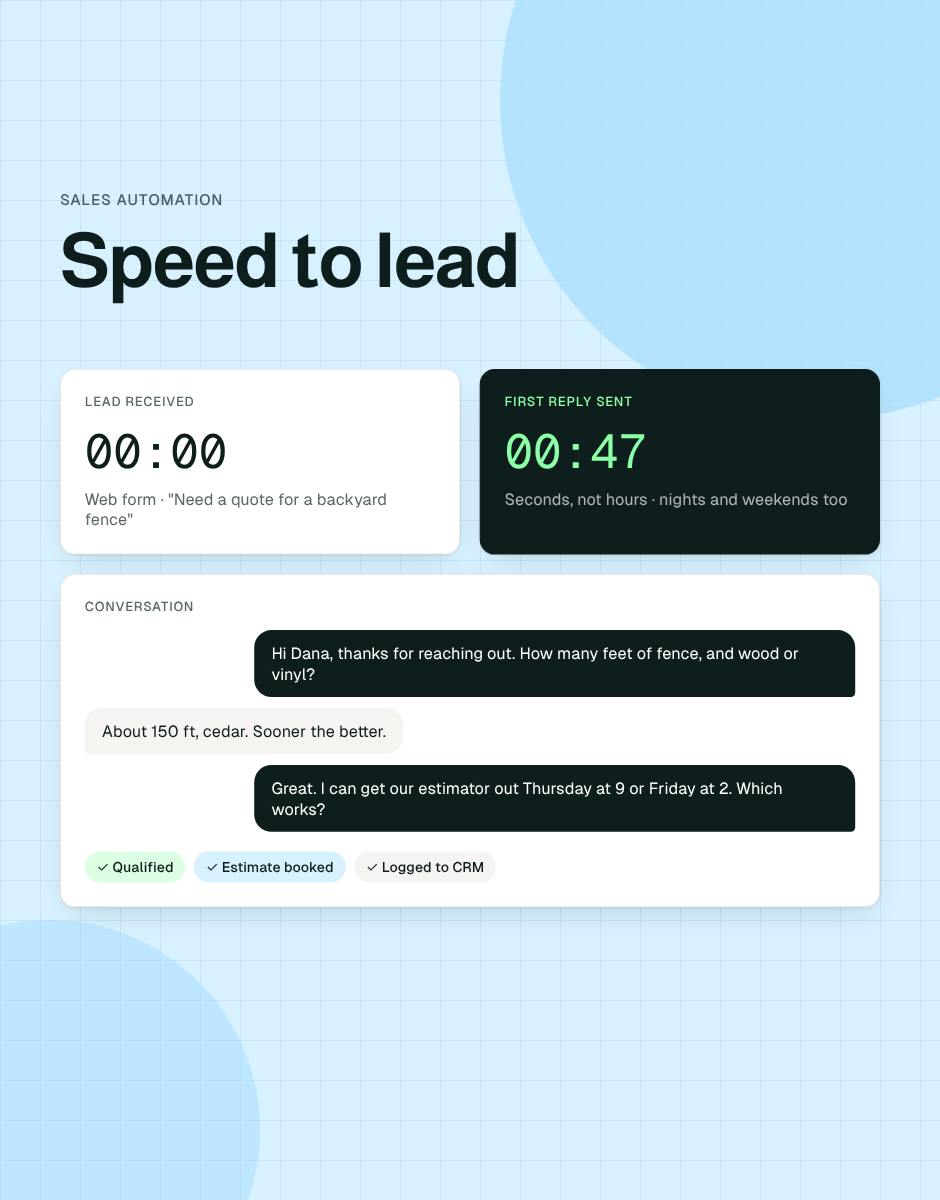
Speed to lead is the time between a prospect raising their hand and your business making meaningful contact. The hand-raise might be a web form, a missed call, a quote request, a chat message or a Facebook lead ad. Meaningful contact means a real reply that moves the conversation forward, not an auto-responder that says we got your message.
It is the cheapest growth lever most service businesses have, because you have already paid for the lead. Every hour you wait, someone else is answering it.
What the research says about lead response time
The most-cited study is still the one Oldroyd, McElheran and Elkington published in Harvard Business Review in 2011, after submitting web leads to companies and timing the responses. The findings:
That research is fifteen years old, and buyer expectations have only moved one way since. Today people expect a reply about as fast as a text message, and they submit the same request to three competitors at once.
Where the “five-minute rule” comes from
You will often hear that you should respond to every lead within five minutes. Treat it as a practical target rather than a law of physics: the research is clear that the first hour matters enormously, and minutes are now the competitive bar. The good news is that once the first response is automated, five minutes costs the same as five seconds, at 2 a.m. on a Sunday as much as 10 a.m. on a Tuesday.
Why most teams are slow (and it isn't effort)
Salespeople can't fix this by trying harder. Salesforce’s State of Sales research found reps spend just 28 percent of their week actually selling; the rest disappears into admin, data entry and internal work. In owner-led service businesses it is worse, because the person who should call the lead back is also the person running the job site.
- Leads arrive when nobody is watching: evenings, weekends, while the crew is on a roof.
- Leads arrive in too many places: the website form, a Google Business message, the office line, a text to the owner's cell.
- Routing has gaps: round robin skips someone on vacation and nobody notices for a week.
- Nobody follows up on the quote. The estimate goes out, the customer goes quiet, and the deal dies of neglect rather than price.
How to automate speed to lead
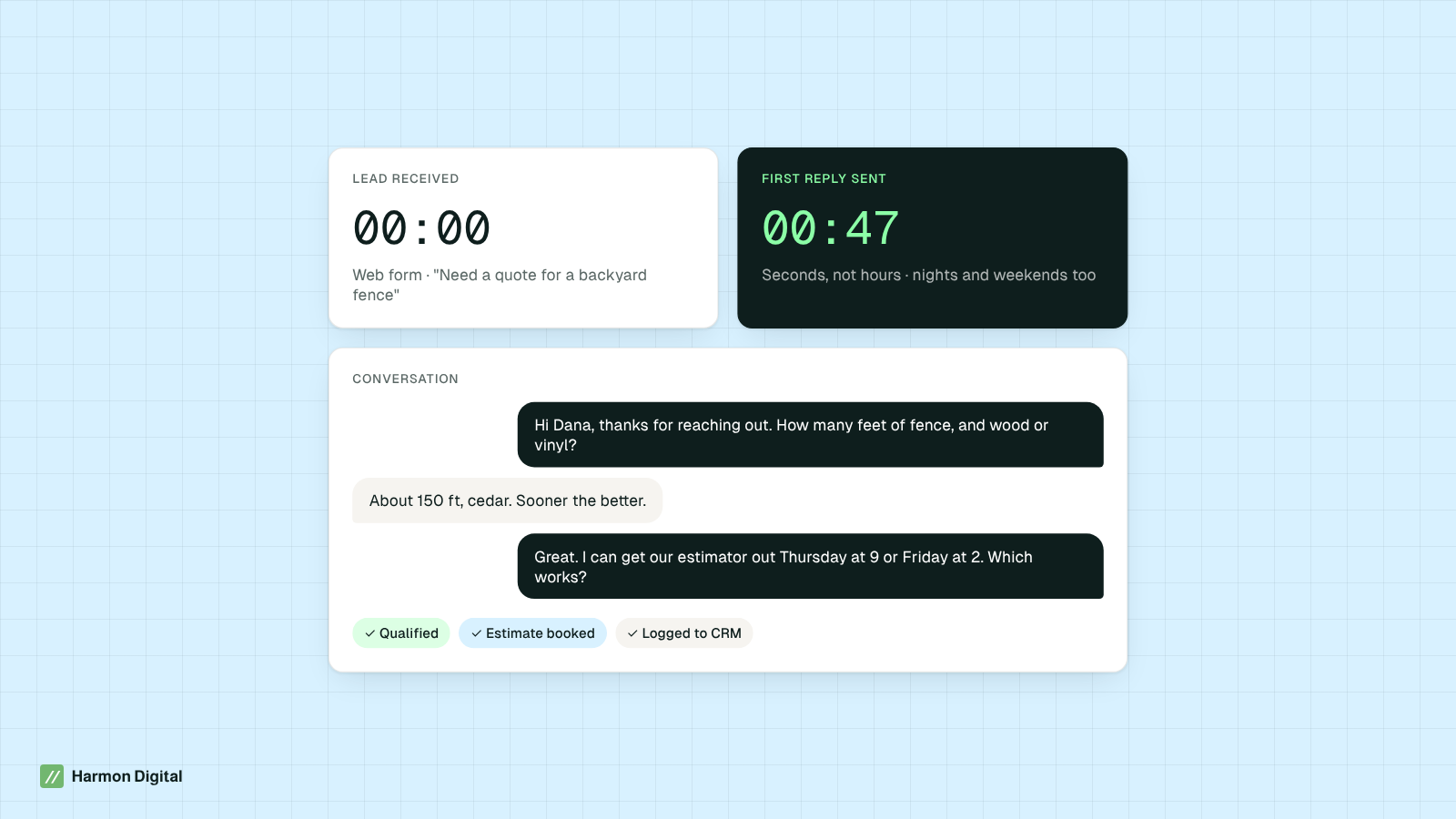
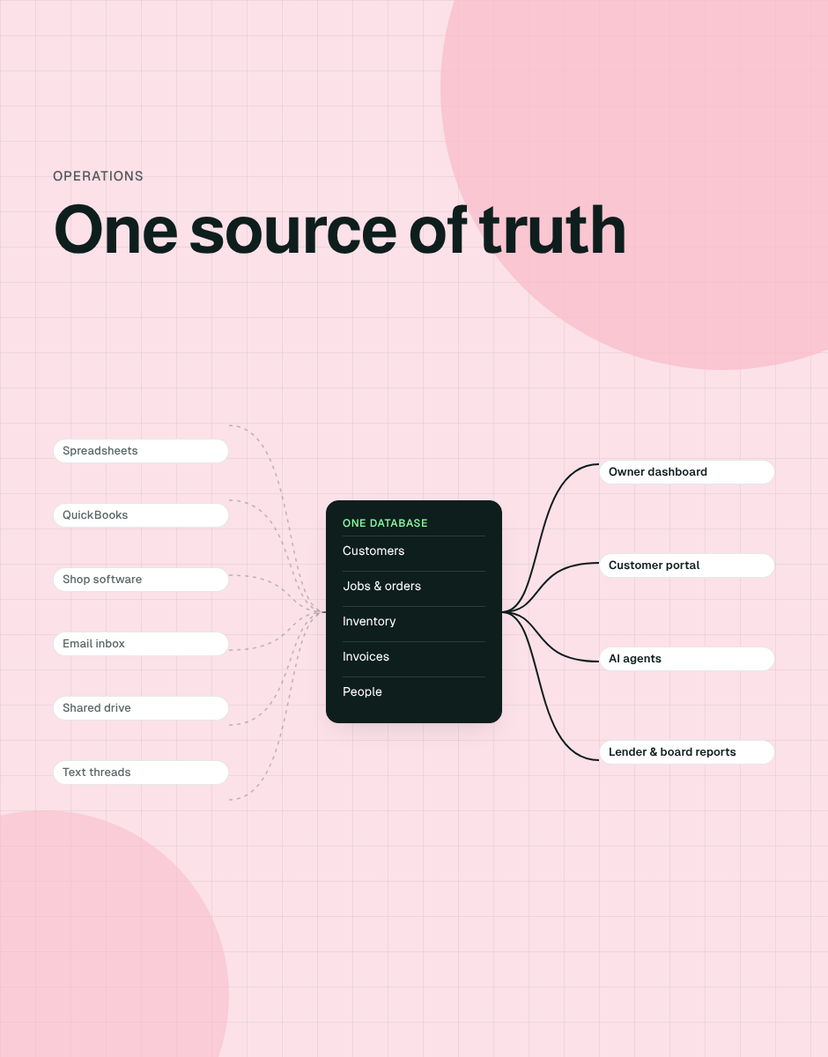
- Capture every source into one place. Web forms, call tracking, ad platforms and inboxes should all land in the same CRM record. If leads live in four places, nothing downstream works.
- Send a real first reply within a minute, by text and email. Personal, specific to what they asked for, signed by a human name, and ending in a question.
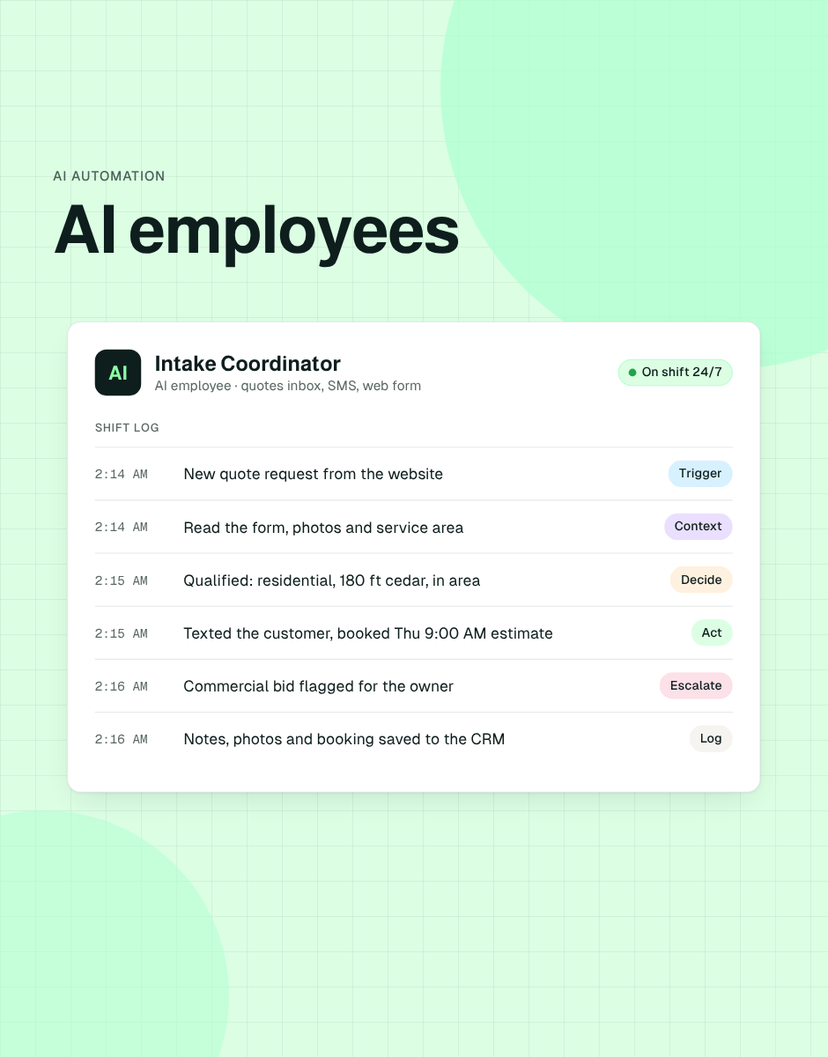
- Qualify with three to five questions. Scope, location, timing, budget range. An AI agent can hold this conversation naturally and stop asking the moment it has enough.
- Book directly onto the calendar. Offer two real times. Every extra message between interest and an appointment loses people.
- Route and alert. The right rep or estimator gets the booking with the full conversation attached, and the urgent or high-value ones get a phone alert.
- Run the follow-up cadence automatically. No reply? Follow up at sensible intervals until they answer or say no.
- Log everything to the CRM. So you can measure it, and so a person who picks up the thread knows what has already been said.
Quote follow-up: the other half of speed to lead
Speed matters at the back of the funnel as much as the front. A quote that goes out without a follow-up plan is a coin flip. Automate the quote flow: quotes, deposit invoices and e-signatures go out on their own, every quote is tracked, and a manager approves any deal whose margin falls below target.
How to measure speed to lead
| Metric | How to calculate it | What good looks like |
|---|---|---|
| Median time to first response | Median minutes from lead created to first real reply | Under 5 minutes, 24/7 |
| % contacted within 5 minutes | Leads with a reply in ≤5 min ÷ all leads | Above 90% once automated |
| Contact rate | Leads who reply at least once ÷ all leads | Trending up month over month |
| Booking rate | Appointments booked ÷ contacted leads | Your baseline, then +X% after launch |
| Close rate by response bucket | Close rate for <5 min, 5–60 min, 1–24 hr, 24 hr+ | Shows the real dollar value of speed in your business |
Use medians, not averages. One lead that sat over a long weekend will make an average look terrible and tell you nothing.
Common speed-to-lead mistakes
- Fast but robotic. "Thank you for your submission" is not a response. Reply to what they actually asked.
- Too many questions up front. Every extra field or question costs conversions. Ask what you need to book, not everything you'll eventually need.
- No hand-off. The automation books the appointment but the estimator never sees the conversation.
- Measuring the wrong clock. Track time to a meaningful reply, not time to the auto-responder.
Speed to lead is usually the first thing we fix in a new portfolio company because it pays back in weeks. It is also a good introduction to the broader idea of AI employees: software that owns a repeatable part of a job, end to end.
Frequently asked questions
What is a good speed to lead?
Under five minutes, every time, including nights and weekends. Research in Harvard Business Review showed that replying within an hour made companies nearly seven times as likely to qualify a lead as waiting an hour longer; with automation, minutes are achievable and now expected.
What is the five-minute rule for leads?
It is the sales guideline that every inbound lead should get a meaningful response within five minutes of arriving. It is best treated as a practical target: the first hour clearly matters most, and automation makes a sub-five-minute reply effectively free.
Can AI handle speed to lead?
Yes, and it is one of the best first uses of AI in a service business. An AI agent can reply personally, ask qualifying questions, book the appointment and log everything to the CRM, then hand the qualified lead to a person. The best results come when the agent can read your real pricing and calendar rather than guess.
Does speed to lead matter for B2B companies?
Yes. B2B buyers also contact several vendors at once and tend to engage with the first credible reply. Response speed signals how you'll treat them as a customer.
How do I measure my current speed to lead?
Pull the last 90 days of leads from your CRM or inbox, record when each arrived and when it got a real reply, and calculate the median. Then break close rates out by response-time bucket to see what speed is worth in your business.
Sources
- The Short Life of Online Sales Leads — Harvard Business Review, 2011
- Sales reps spend less than 30% of their time actually selling — Salesforce, 2022

Isaac Harmon · Founder, Harmon Digital
Isaac runs Harmon Digital, which builds custom software and AI employees for private equity portfolio companies, and built Unstack, the platform behind those builds. Finance degree from Mizzou; seven businesses started before 21, so he has been on the operator's side of messy systems.