Why systems decide the first 100 days
Acquisitions have a reputation for disappointing, and it is earned. A widely cited Harvard Business Review analysis put the M&A failure rate between 70 and 90 percent. PwC’s 2026 M&A Integration Survey is more measured but points the same way: only about one in three acquirers fully achieve their deal thesis objectives.
The same PwC survey found that technology and data enabled at least a quarter of synergies for nearly nine in ten acquirers. In practice, the systems workstream is where integration plans quietly stall: nobody has admin access to the CRM, the numbers in the board pack don't tie to the bank, and the add-on is still invoicing from its own software six months later.
This checklist is the systems workstream of a 100-day plan for a lower-middle-market company. It assumes no in-house IT team, which is the normal case.
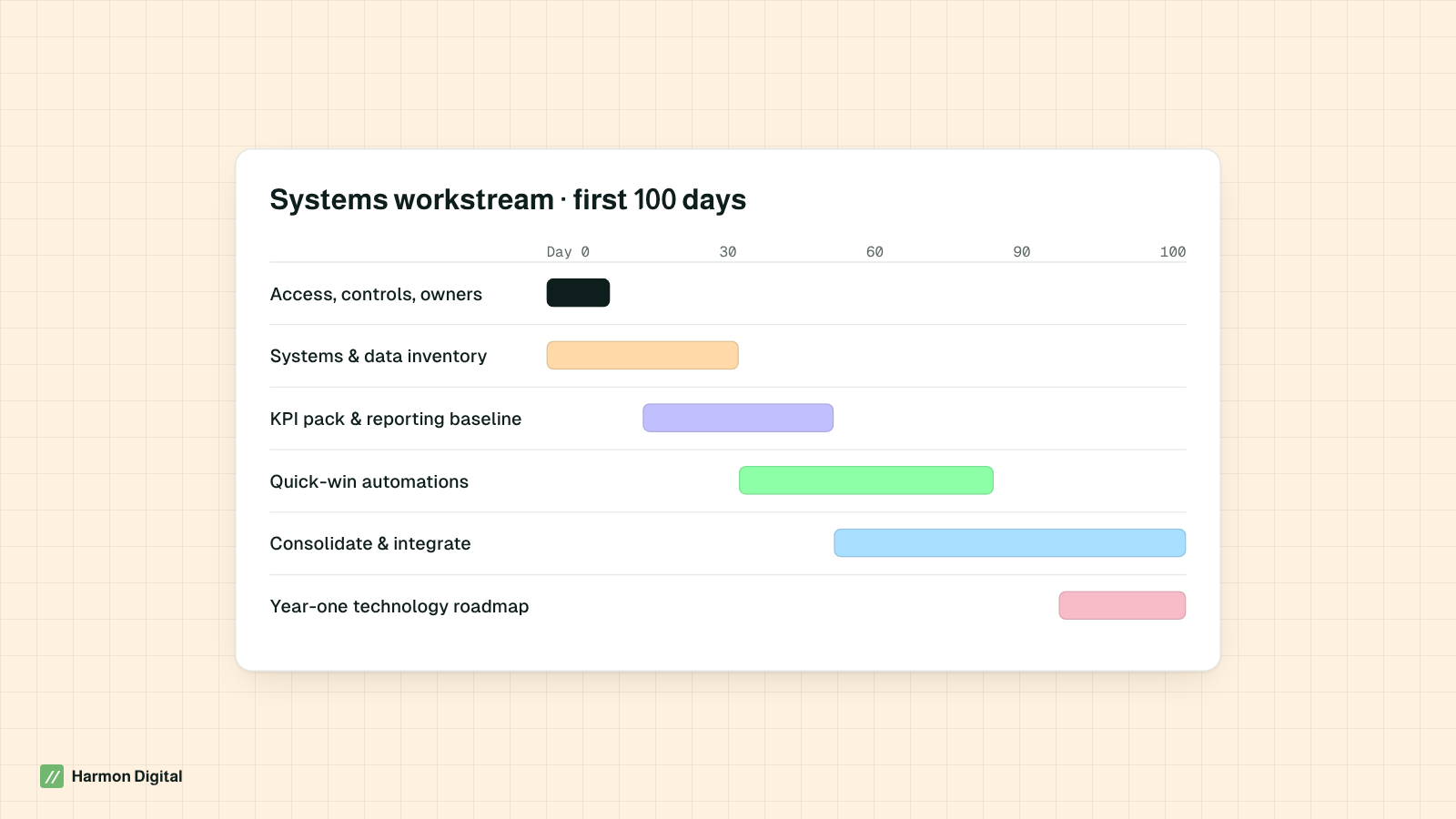
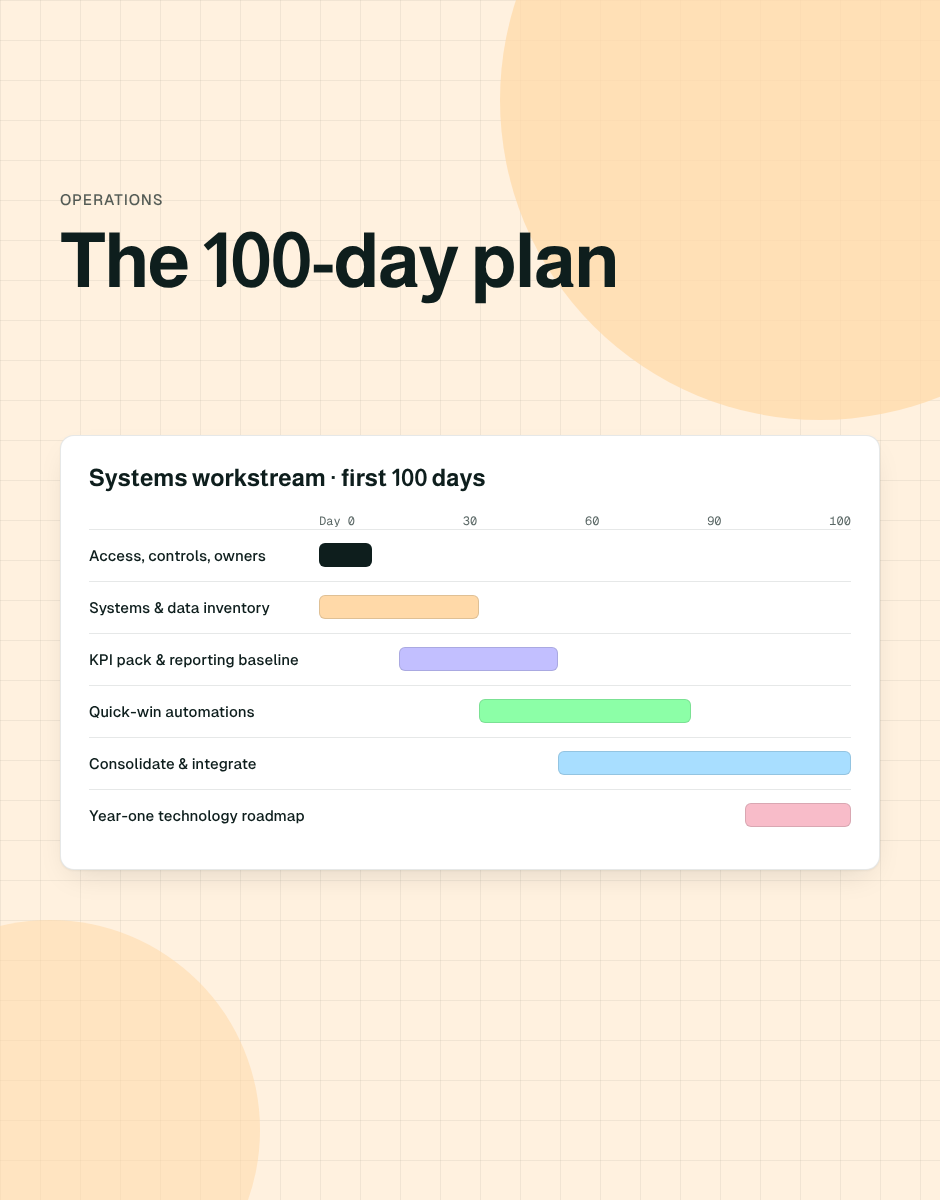
Days 0–10: Access, controls and owners
Before improving anything, make sure the new owners control everything. This is the most skipped step and the most painful to fix later.
- Admin access, in the company's name, to: domain registrar and DNS, email, accounting, payroll, banking, website, CRM and every line-of-business system.
- Multi-factor authentication on email, banking, payroll and accounting at minimum.
- A company password manager, with shared credentials moved out of notebooks, spreadsheets and the previous owner's head.
- Departed owners and contractors removed or downgraded, with a log of what was changed.
- Confirmation that backups exist and that you can actually restore from them.
- A list of which card or account pays for every subscription, so nothing lapses when the seller's card is cancelled.
Days 0–30: Systems and data inventory
Next, write down how the business actually runs, not how the CIM said it runs. Sit with the people doing the work and follow an order from first call to cash collected.
| Field | Why it matters |
|---|---|
| System or spreadsheet name | Spreadsheets that run the business count as systems |
| Business owner and admin | Who decides and who has the keys |
| Monthly cost and seats used | Feeds consolidation decisions later |
| Data it holds | Customers, orders, inventory, money, people |
| What it connects to (or doesn't) | Where re-keying and errors happen |
| Hours per week of manual work around it | Where the quick wins are |
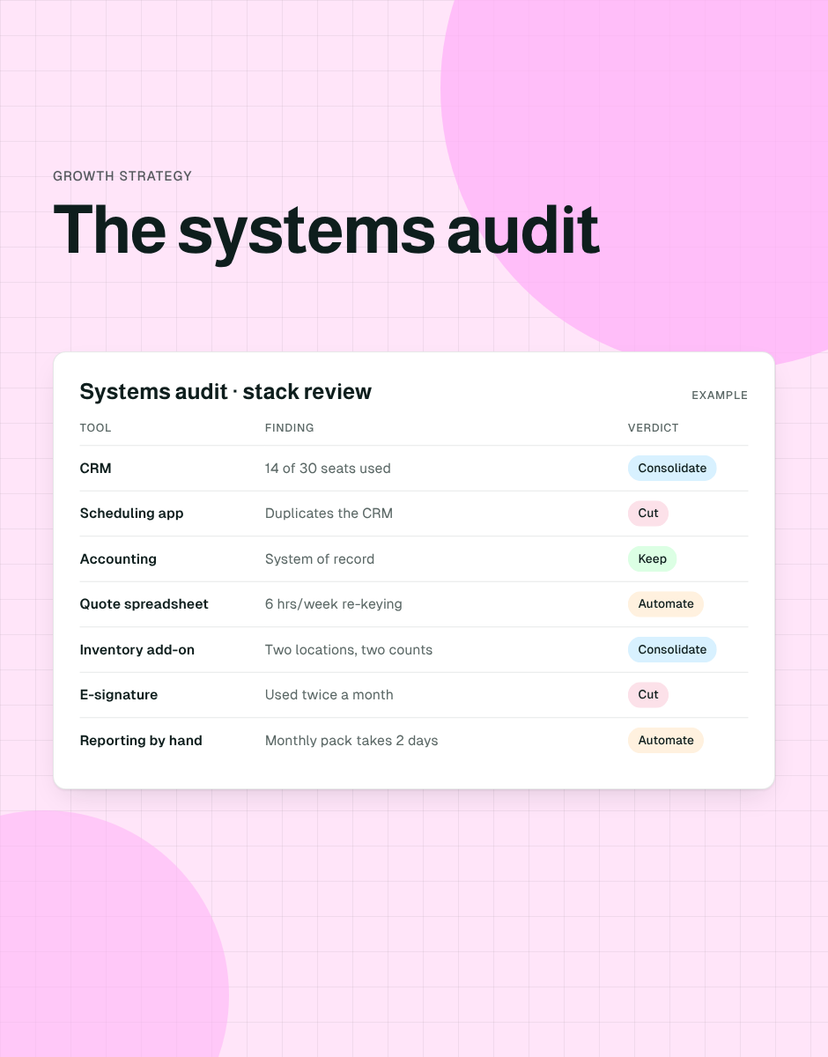
This inventory is the backbone of a full systems audit, which turns the list into a costed roadmap.
Days 15–45: A KPI pack and reporting baseline
You can't manage what arrives three weeks after month end in a spreadsheet nobody trusts. Agree on a short weekly flash report and build it from source systems, not from someone's copy-paste:
- Cash and 13-week cash forecast
- Bookings, pipeline and backlog
- Revenue and gross margin by line of business
- Accounts receivable aging
- Labor hours and utilization
- Two or three operating metrics that actually drive this business (response time, jobs completed, on-time delivery)
The first version can be rough. What matters is that it comes from the same place every week, so trends mean something.
Days 30–70: Quick-win automations
With the inventory in hand, pick the two or three automations that pay back inside a quarter. They are usually the same ones:
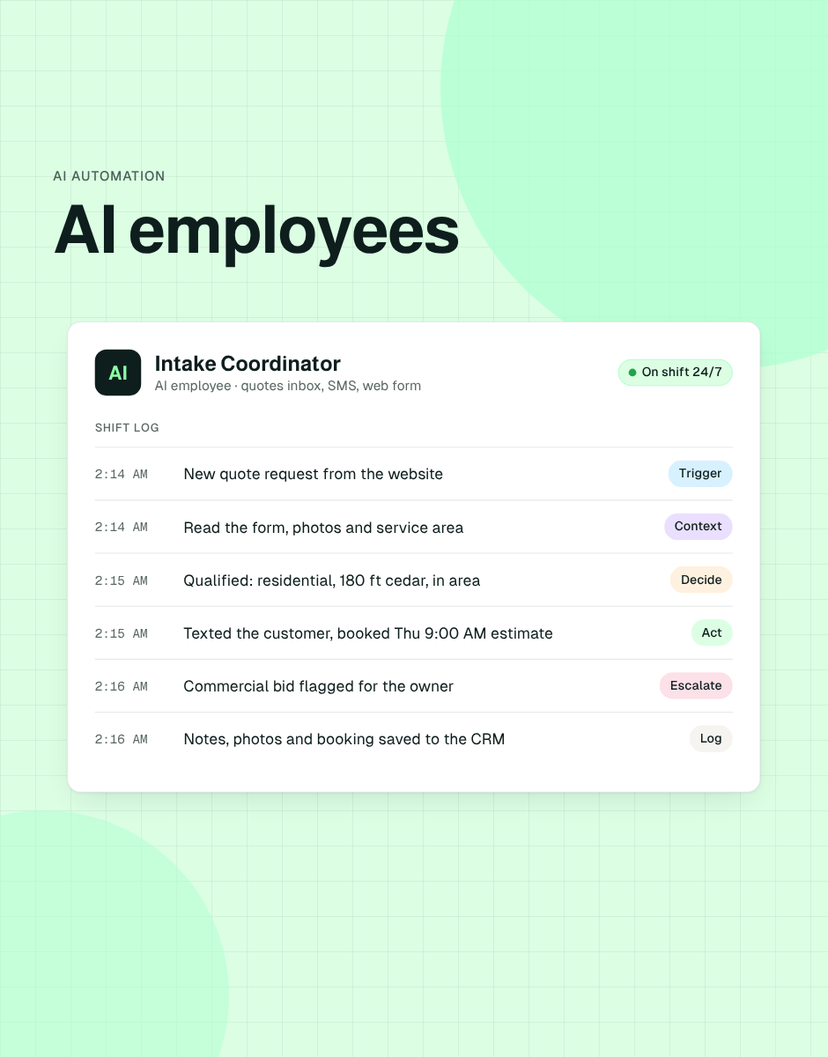
- Lead response and quote follow-up. The fastest revenue lever in most service businesses. See speed to lead.
- Invoicing and collections reminders. Shorter days sales outstanding is cash you can see within weeks.
- Recurring reports. Kill the two-day month-end copy-paste ritual.
- Internal lookups. Answers from SOPs and documents in seconds, the way our Slack agent for Neighbors Bank answers loan officers' guideline questions.
Quick wins buy credibility with the management team for the harder consolidation work that follows.
Days 45–100: Consolidate and integrate
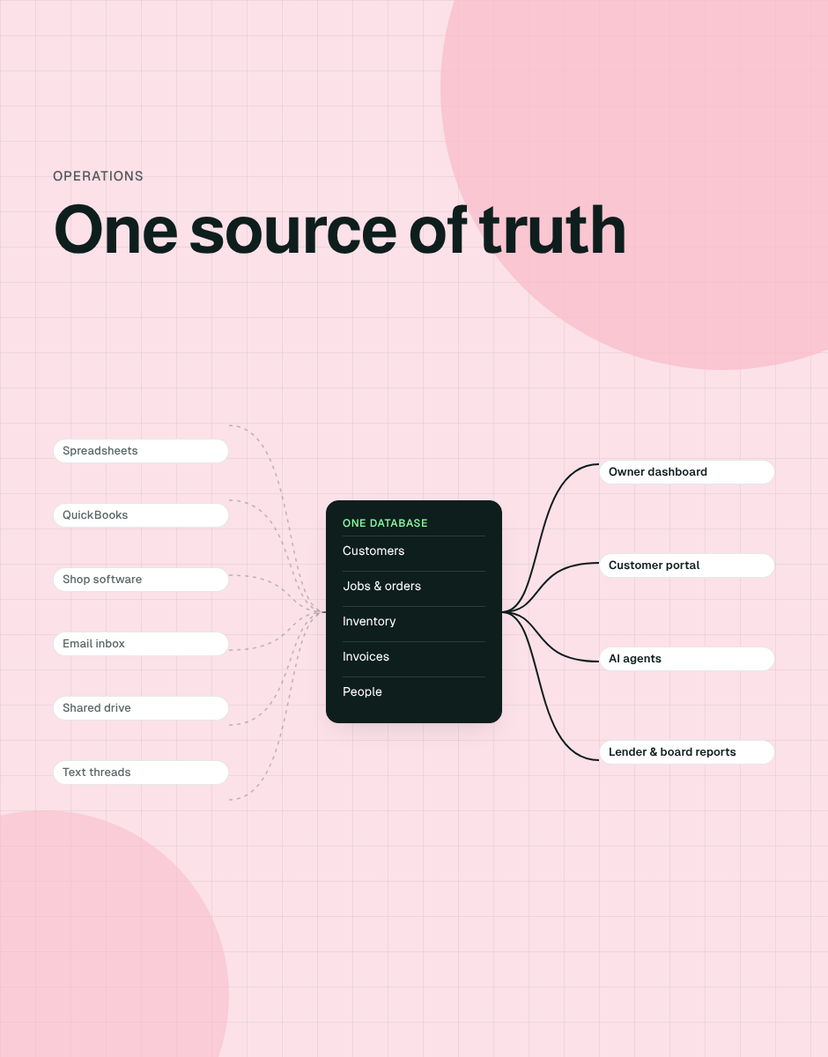
Now decide where the data should live. For a platform company this usually means one source of truth for customers, jobs or orders, inventory and people, with accounting staying in the accounting system and syncing to it.
For add-on acquisitions, integration is where the platform thesis is won or lost:
- Map the add-on's chart of accounts to the platform's so the numbers roll up on day one of reporting.
- Migrate customers and open jobs into the platform's CRM or database; archive the rest with a read-only export.
- Unify inventory and pricing across locations so sales can sell what the whole company has.
- Retire overlapping tools only after the replacement has run in parallel for at least one full cycle.
Our guide to building a single source of truth covers the build-versus-buy decision in detail.
Days 80–100: The year-one technology roadmap
Close the 100 days with a one-page roadmap the board can hold management to: each initiative, the EBITDA line it moves, the owner, the cost and the date. Make build, buy or extend decisions here, with the inventory and baseline in hand, rather than in week one under pressure. This is also the moment to decide where AI employees will take on high-volume work.
For search fund and independent sponsor buyers
Search fund entrepreneurs face the same checklist with fewer hands. Stanford GSB has tracked more than 850 search funds since 1996, and its 2026 Search Fund Study reports an aggregate IRR of 33.9 percent and a 4.75x ROI as of the end of 2025. Many searchers spend their first months listening rather than changing things, which is wise for people and culture. Systems are the exception: access, backups and a basic inventory should still happen in the first weeks, because they protect the asset you just bought.
The difference is sequencing, not content. A searcher might take the full year for what a sponsor-backed team does in 100 days. Just don't skip the first ten.
Frequently asked questions
What is a 100-day plan in private equity?
A 100-day plan is the set of priorities, owners and milestones a sponsor and management team commit to in the first 100 days after closing. It typically covers leadership, financial reporting, quick commercial wins, cost actions, systems and integration, and it sets up the longer value creation plan.
What should be on a post-acquisition integration checklist for systems?
At minimum: admin access and controls for every system, multi-factor authentication, backups, a full systems and data inventory, a weekly KPI pack from source systems, a short list of quick-win automations, a plan for consolidating data and integrating add-ons, and a year-one technology roadmap.
Should we choose an ERP in the first 100 days?
Usually not. Select systems after you have an inventory, a reporting baseline and clear requirements. Many lower-middle-market companies don't need a full ERP at all; they need one operational source of truth that syncs with their accounting system.
How do you integrate an add-on acquisition's systems?
Map its chart of accounts to the platform's first so reporting rolls up immediately, then migrate customers, open jobs and inventory into the platform's systems, run old and new in parallel for at least one cycle, and only then retire the add-on's overlapping tools.
Who should own the systems workstream?
One named person on the management team, usually the CFO or COO, with an operating partner overseeing and an outside builder doing the technical work where there is no internal IT team.
Sources
- The Big Idea: The New M&A Playbook — Harvard Business Review, 2011
- PwC's 2026 M&A Integration Survey — PwC, 2026
- Search Funds Keep Offering a Proven Path to Ownership — Stanford Graduate School of Business, 2026

Isaac Harmon · Founder, Harmon Digital
Isaac runs Harmon Digital, which builds custom software and AI employees for private equity portfolio companies, and built Unstack, the platform behind those builds. Finance degree from Mizzou; seven businesses started before 21, so he has been on the operator's side of messy systems.