What is an AI employee?
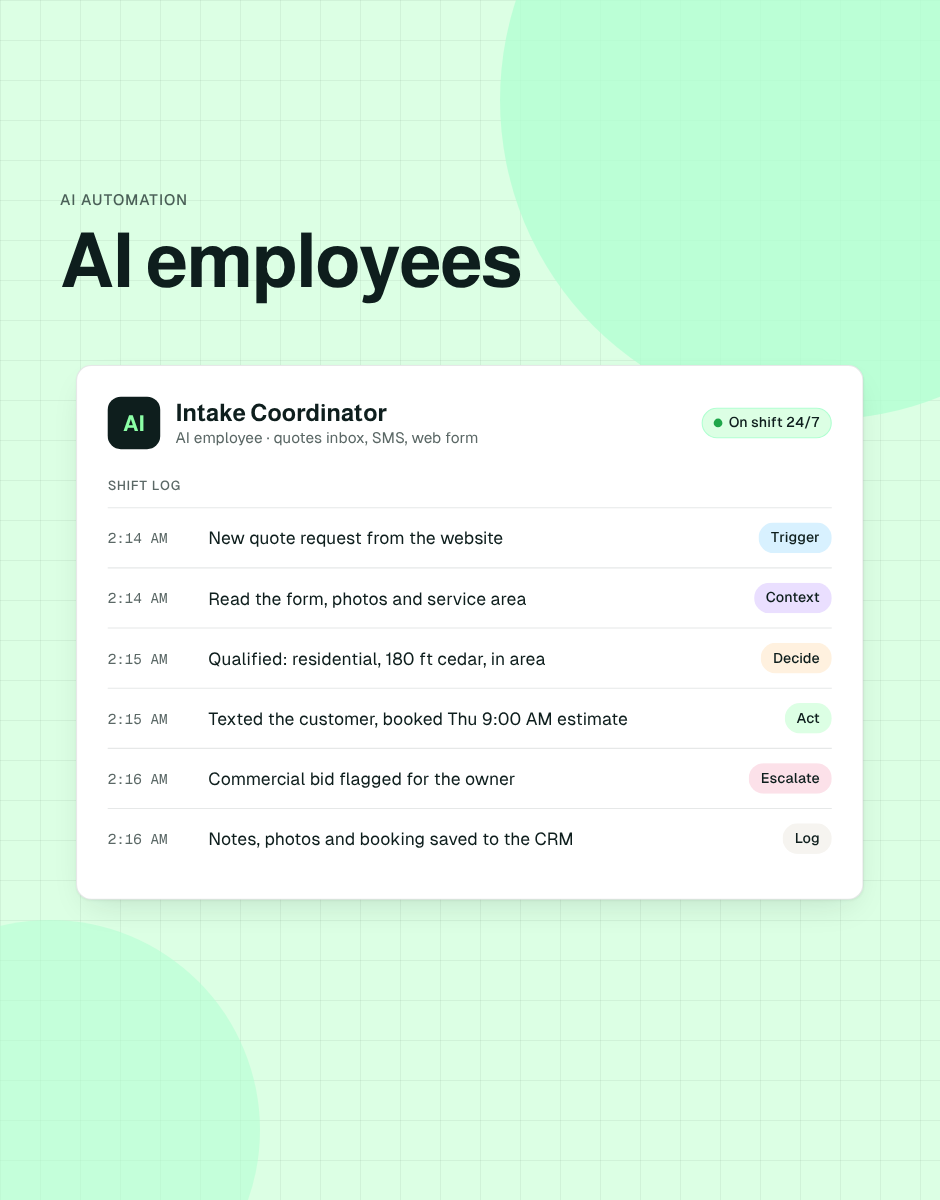
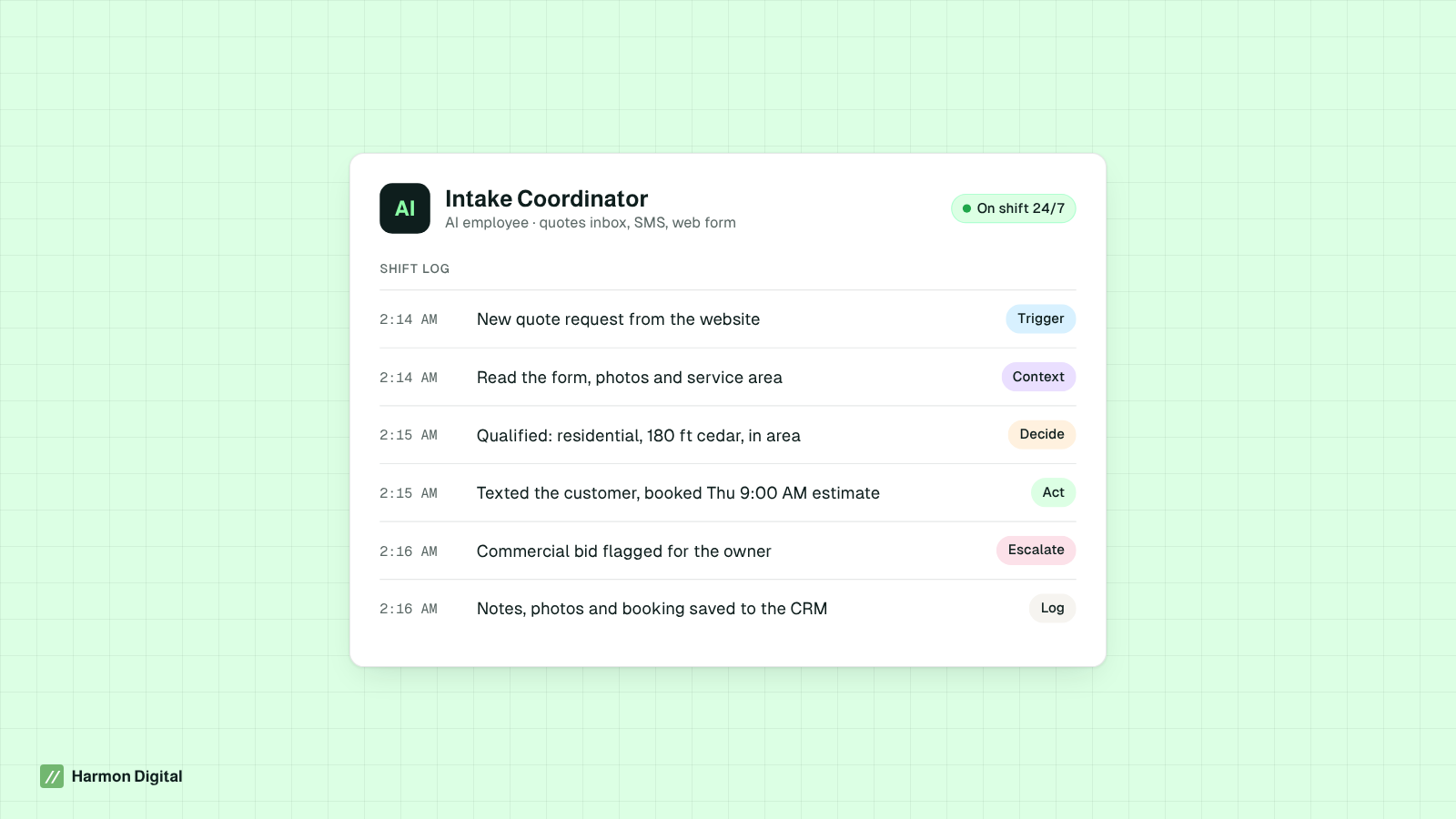
The phrase gets used loosely, so here is the definition we build to. An AI employee is software that owns a defined slice of a job, end to end. It watches for work to arrive (an email, a web form, a text, a new row in a table), reads whatever context it needs, makes a decision inside rules you set, takes action in your real systems, and hands the case to a person when it needs judgment it doesn't have. Then it writes down what it did.
That last-mile difference is the whole point. A chatbot answers questions. A traditional automation moves data from A to B when a rule fires, and breaks when the input is messy. An AI employee sits between the two: it can read a rambling customer email, a photo of a handwritten order or a 40-page lending guideline, and it can actually do something about it: book the appointment, update the order, draft the reply, flag the exception.
| Chatbot | Rule-based automation | AI employee | |
|---|---|---|---|
| Handles messy, unstructured input | Partly | No | Yes |
| Takes action in your systems | Rarely | Yes | Yes |
| Knows when to escalate to a person | No | No | Yes, by design |
| Owns an outcome (a booked estimate, a captured order) | No | Partly | Yes |
| Typical example | Website Q&A widget | "When a form is submitted, add a row" | Qualifies a lead and books the estimate at 2 a.m. |
Why AI employees are practical now
Adoption is no longer the question. In McKinsey’s 2025 State of AI survey, 88 percent of respondents reported regular AI use in at least one business function, 23 percent said they were already scaling agentic AI, and another 39 percent had begun experimenting with AI agents.
Results are the question. When MIT’s NANDA initiative published The GenAI Divide in 2025, Fortune summarized the finding bluntly: for 95 percent of companies in the dataset, generative AI implementation was falling short. In our experience the failures share a pattern. The AI is a separate tab people are supposed to remember to open. It can talk, but it can't touch the CRM, the inbox or the schedule, so a person still has to do the work it describes.
The gap between those two numbers is where the money is. Almost every business is using AI. Very few have given it a job.
Where AI employees pay off first
The roles that pay back fastest share three traits: the work arrives in high volume, it follows rules you could write down, and speed matters. Five that show up in almost every portfolio company we work with:
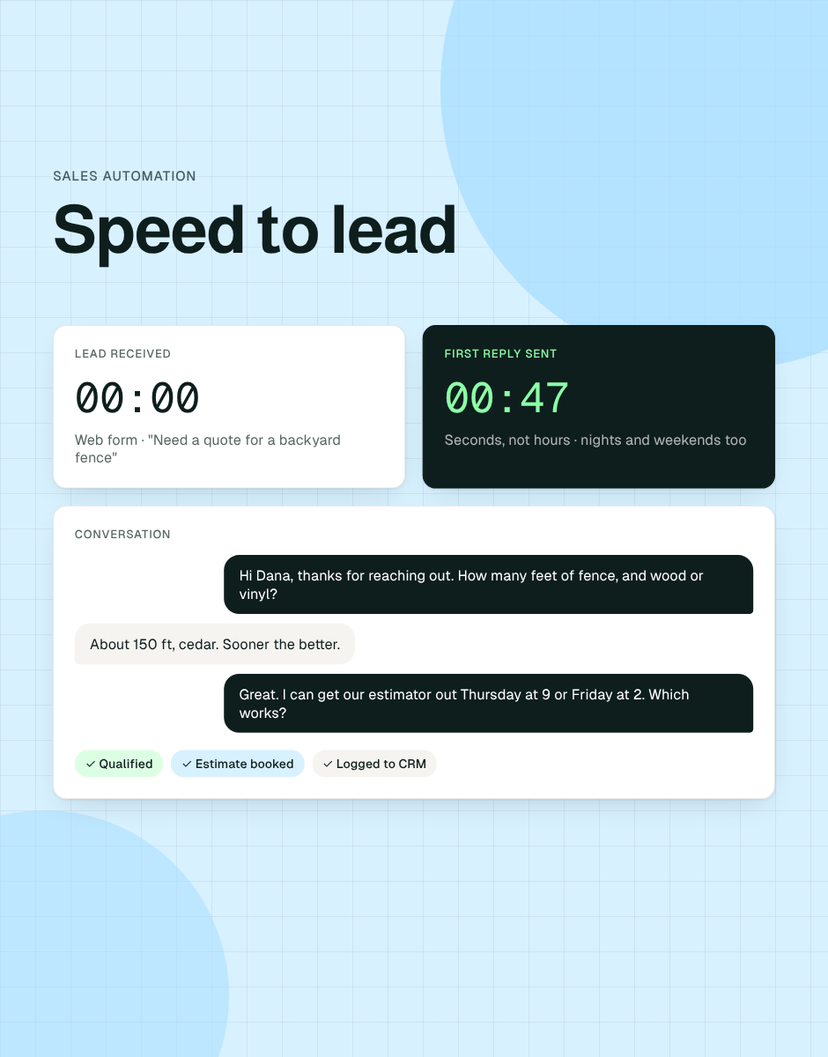
- Lead intake and quote follow-up. The classic: reply in seconds, ask the qualifying questions, and book the estimate while the customer is still deciding. More on the economics in our guide to speed to lead.
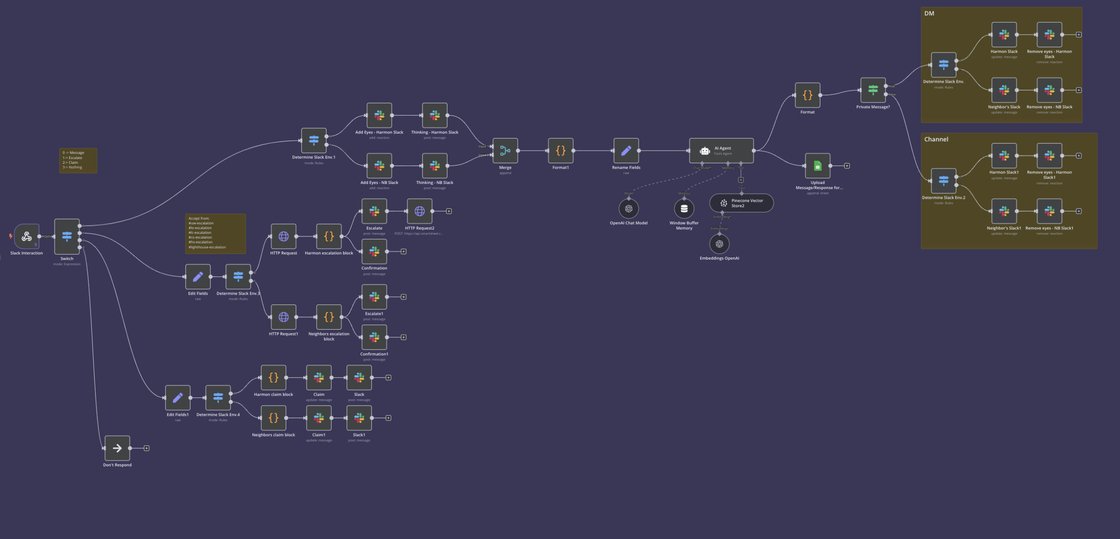
- Internal knowledge lookup. At Neighbors Bank, a national mortgage lender, loan officers had to dig through agency handbooks and the bank's own overlays to answer guideline questions. We built an AI agent in their Slack that answers from those documents in seconds, lists the files it used, and hands anything uncertain to an underwriter with one click.
- Order capture from email. Happy Endings, a London ice cream maker, takes most wholesale orders by email. Their order agent reads each email and creates the order in their system, and staff approve any change to an existing order.
- Scheduling, reminders and rescheduling. Anything that today is a person playing phone tag with a calendar.
- Recurring reporting. The weekly flash report or month-end pack someone assembles by copying numbers out of three systems.
What does an AI employee cost?
Price it against the job it does, not against a software subscription. The U.S. Bureau of Labor Statistics puts median pay at $38,010 a year for receptionists and $44,770 for customer service representatives (2025 figures). That is before payroll taxes, benefits, recruiting, training, turnover, and the evenings and weekends when nobody is answering at all.
An AI employee has three cost lines instead:
| Cost line | What it covers | How it scales |
|---|---|---|
| Build (one-time) | Scoping the job, writing the rules, connecting your systems, testing on real cases | With the number of systems and edge cases |
| Run (monthly) | AI model usage, hosting, monitoring | With volume, not with headcount |
| Human oversight | Reviewing escalations, tuning rules as the business changes | Shrinks as the AI earns autonomy |
Our own builds start at $7,500 on the Done For You plan, and most single-role AI employees go live in four to eight weeks. The right comparison is rarely AI versus a person. It is the person you already have, plus an AI employee, versus the second and third hires you were about to make.
How to deploy an AI employee without becoming a failed pilot
- Pick one job with a number attached. Response time, orders captured, hours spent on lookups. If you can't measure it today, measure it for two weeks before you build anything.
- Write the SOP the way you would train a new hire. What arrives, what good looks like, what to never do, and exactly when to hand off to a person.
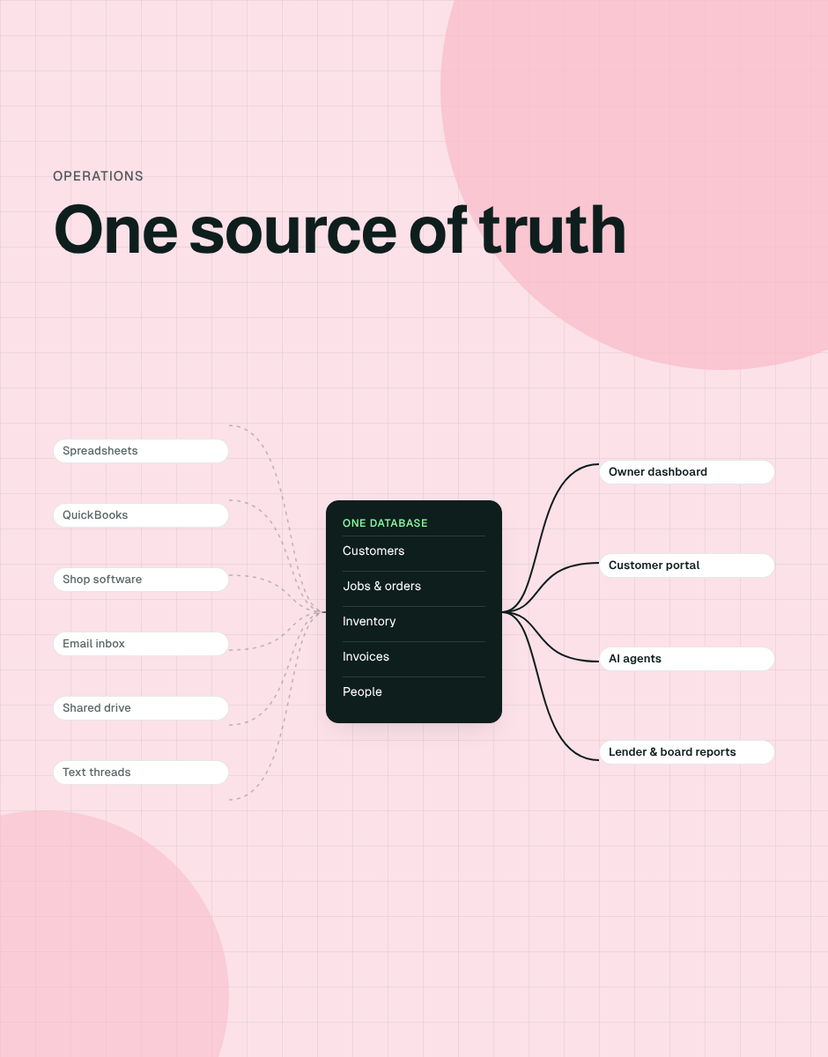
- Connect it to the systems of record. The AI should read from and write to the CRM, inbox, calendar and accounting system directly. A chat window on the side is how pilots die.
- Run it in shadow mode first. For a week or two it drafts and a person approves. You learn where it is wrong while the stakes are zero.
- Grant autonomy case by case. Let it run alone on the cases it gets right every time; keep a person on the rest.
- Review the log weekly. Every action should be written down. Ten minutes a week with the log is how the AI gets better and how you keep trusting it.
What an AI employee should not do (yet)
Be honest about the edges. Today’s models are excellent at reading, classifying, drafting and following procedure. They are not where you want final authority on irreversible, high-stakes or regulated decisions: approving a loan, pricing a large commercial bid, firing a vendor, giving medical advice. In those cases the AI prepares and the person decides.
Relationships stay human too. The agent books the estimate; the owner still walks the yard and shakes the hand. That division of labor is the design, not a limitation.
AI employees in private equity portfolio companies
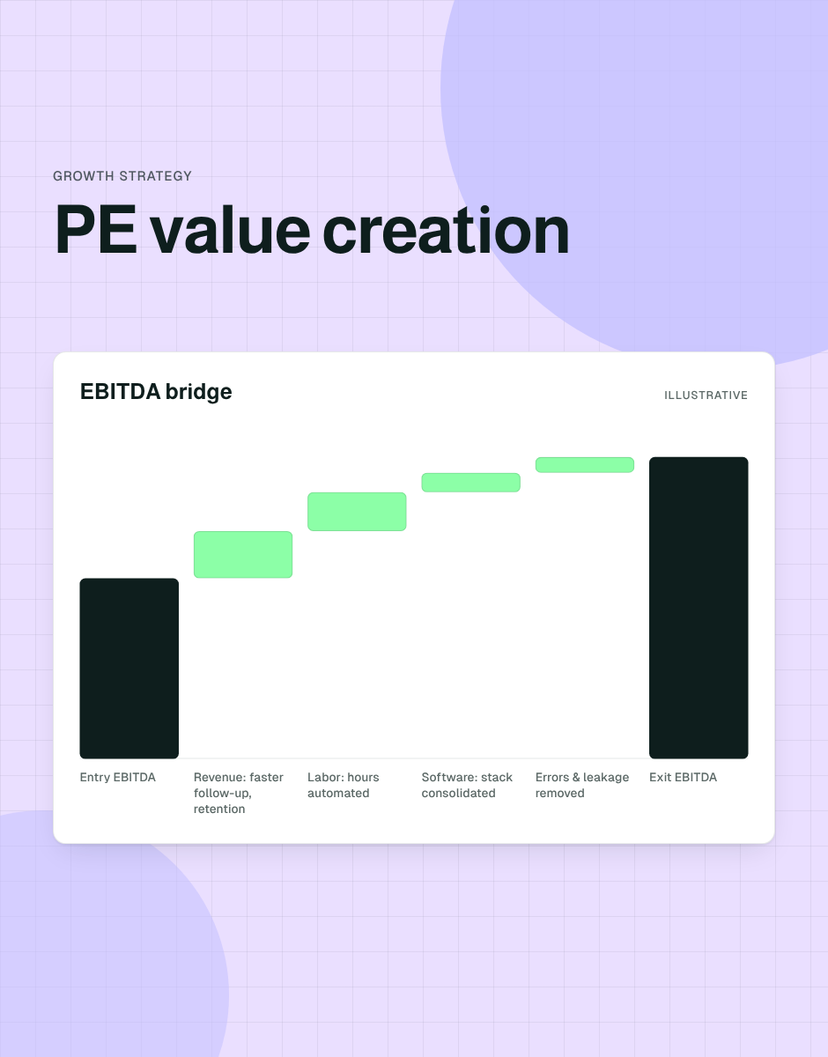
Private equity is where AI employees make the most sense, because the math has changed. Bain’s 2026 Global Private Equity Report notes that typical deals now need around 10 to 12 percent average annual EBITDA growth to reach a 2.5x return, with holding periods near seven years. Growing capacity without growing headcount is one of the few levers a lower-middle-market company can pull quickly.
There is an exit angle as well. A documented, owned system that does real work is an asset a buyer can diligence. We cover the full set of levers in our technology playbook for private equity value creation.
Frequently asked questions
Is an AI employee the same as an AI agent?
Close. An AI agent is the technology: a model that can use tools and take steps toward a goal. An AI employee is an agent given a specific job, access to the systems that job needs, rules, an escalation path and a log. Every AI employee is an agent; most agents are not employees.
Will an AI employee replace my staff?
In the companies we work with, it usually replaces the hire you were about to make and the overtime you were already paying. Existing staff move up to the work that needs judgment and relationships, and the AI takes the repetitive volume.
How long does it take to deploy an AI employee?
A single, well-defined role typically takes four to eight weeks to reach a first live version, including a shadow-mode period, and then improves with use. Our Neighbors Bank Slack agent went live in the bank's Slack about two months after the tools were chosen.
Is an AI receptionist an AI employee?
It can be. An AI receptionist that only answers the phone and takes a message is closer to a chatbot. One that qualifies the caller, books the appointment in your calendar, updates the CRM and escalates the urgent calls is an AI employee.
What does an AI employee need access to?
Only what the job needs: usually the inbox or phone line where work arrives, the CRM or database where it is recorded, and a calendar or order system where it acts. Access should be scoped to that role, and every action logged.
Sources
- The state of AI in 2025: Agents, innovation, and transformation — McKinsey, 2025
- MIT report: 95% of generative AI pilots at companies are failing — Fortune, 2025
- Receptionists: Occupational Outlook Handbook — U.S. Bureau of Labor Statistics
- Customer Service Representatives: Occupational Outlook Handbook — U.S. Bureau of Labor Statistics
- Global Private Equity Report 2026 (press release) — Bain & Company, 2026

Isaac Harmon · Founder, Harmon Digital
Isaac runs Harmon Digital, which builds custom software and AI employees for private equity portfolio companies, and built Unstack, the platform behind those builds. Finance degree from Mizzou; seven businesses started before 21, so he has been on the operator's side of messy systems.