Why I'm breaking this one down
David Shapiro has been one of the most consistent voices on what AI does to work. His new video, The Last 5 Years of Labor, is ten and a half minutes long, went up on October 29, and passed 200,000 views within a few days. It's short, but almost every sentence carries a claim, a company example or a number.
I'm writing it up because it lines up almost exactly with what I see building automation for private equity portfolio companies and owner-operators. The core idea, that automation happens one value stream at a time, is how we already scope every project. Below is the whole video, section by section: the original thesis, what he changed his mind about, every example and stat he cites, and then my take on what it means if you run a business. If you want to jump around, the timestamps are in the chapter guide at the bottom.
The question that started it
The video opens with a comment someone left on his channel: does he still believe in the automation cliff? His answer is yes, and that it's happening right now. But he says he got one part of the story wrong, and the rest of the video is the correction. (0:02)
Some background on the original claim. In his book Labor Zero, which is up for pre-order, Shapiro wrote that he could see the automation cliff approaching. He forecast that labor displacement would accelerate sharply, with an inflection point before 2030. In February 2025 he made a video called The Last 7 Years of Human Work on the same idea.
The new title is the same clock, just read later. Seven years from early 2025 and five years from late 2026 both land in the early 2030s. What changed isn't the timeline. It's the shape of what happens along the way.
Where the cliff idea comes from
Before he worked on AI, Shapiro was an infrastructure automation engineer, and the cliff comes straight from that job. In infrastructure, automation never arrives gradually. While you're building and testing an automation engine it does nothing at all. Then you turn it on, and it processes everything at once. (0:35)
His example is Terraform, a tool engineers use to set up servers. Whether you want 10 servers or 10,000, you change one number in one file. Same effort either way.
Then the scale example. Back in 2011, Amazon was deploying new code every 11.6 seconds on average, and at the busiest moments 30,000 of its servers were receiving a deployment at the same time.
“Perfect automation is arbitrarily scalable.”
That's his rule of thumb: if you can automate something perfectly 10 times, you can automate it 10 billion times. Hold on to the word "perfectly." It comes back later and it's the most important word in the video.
It's not just servers
He then shows the same thing happening in office work. (1:38)
- The UK's Department for Work and Pensions had a backlog of more than 30,000 pension claims. It switched on 12 software robots, and two weeks later the backlog was gone.
- Airbnb, in 2025, used AI to rewrite thousands of its test files. Its engineers estimated the job would take a year and a half by hand. The AI finished 75% of the files in four hours. (Airbnb's own write-up adds a detail worth knowing: the remaining files took more work, and the full migration wrapped in about six weeks. That last 25% is the march of nines in miniature.)
What he got wrong: there isn't one cliff
Here's the correction. Shapiro says he talked as if the whole economy would go over one cliff at the same time, and that isn't how it works. Nobody automates an entire company at once. Companies automate one task, one workflow or one job at a time, and each of those has its own cliff. (2:11)
Workflows vs. value streams
To explain the unit that actually goes over the cliff, he borrows the idea of a value stream from lean manufacturing:
- A workflow is how the people doing the work see it. His example: the queue of tickets on a support agent's screen.
- A value stream is what that work actually does for the business. Same example: getting every customer an answer.
He cites two lean manufacturing experts writing in 1998 (that's Mike Rother and John Shook's Learning to See) with the idea that wherever there's a product for a customer, there's a value stream, and the hard part is seeing it.
Then the key line of the whole video: when the automation for a value stream works, it takes over the whole volume at once. Not 10% this quarter and 20% next quarter. All of it.
The cliffs that already went over
Next, he walks through companies where a single value stream flipped. (3:12)
| Company | Value stream | What happened |
|---|---|---|
| Klarna (Feb 2024) | Customer service chat | Its AI assistant handled 2.3 million conversations in its first month, about two-thirds of all chats. Klarna said that was the work of 700 full-time agents, and customers got answers in under 2 minutes instead of 11. |
| Salesforce (2025) | Customer support | CEO Marc Benioff said support headcount went from about 9,000 to about 5,000 because he needed fewer people. |
| Duolingo (Apr 2025) | Course creation | The first 100 language courses took about 12 years to build. It launched 148 new courses, built with AI, in about a year. |
| Goldman Sachs | IPO prospectus drafting | A team of six used to spend two weeks writing one. Now AI drafts 95% of it in minutes. |
Look at what's common to all four. In none of them did the company get automated. One stream did. Klarna still has risk, engineering and finance teams. Goldman still has bankers. Duolingo still has people deciding what a good course looks like.
The Goldman example comes with the line from the video I'd tell every service business to think about. CEO David Solomon's point was that the last 5% of a prospectus is what matters now, because the rest has become a commodity. When 95% of the work is nearly free, all of the value (and all of the pricing power) moves into the last 5%: judgment, accuracy, relationships, accountability.
When the cliff doesn't hold
This is the part that makes the video more than a doom forecast. Shapiro asks whether every cliff holds, and answers: not always. (4:31)
- Commonwealth Bank of Australia cut 45 call center jobs in 2025 after putting a voice bot on its new phone lines. A few weeks later the bank admitted those jobs hadn't actually been redundant. It reversed the cuts and apologized.
- Klarna, the poster child from the previous section, had its own CEO admit the company put too much weight on cost and quality suffered. Klarna started hiring people again, and its CEO now describes human support as the VIP treatment.
The catch is the word "perfectly"
Remember the rule of thumb: if you can automate something perfectly ten times, you can do it ten billion times. Traditional software does exactly the same thing every time. AI doesn't. (5:02)
He brings in Andrej Karpathy, one of OpenAI's founders, and what Karpathy calls the march of nines. A demo that works 90% of the time is only the first nine. After that comes 99%, then 99.9%, and every one of those nines takes real work.
So every value stream has to march through its own nines before its cliff arrives. Some get there in months. Others will take years. The Commonwealth Bank story is what it looks like when a company acts on the first nine as if it were the third.
Failures scale too
The flip side of perfect automation scaling is that broken automation scales just as well. His example is Knight Capital in 2012. The trading firm switched on faulty code while trying to fill just 212 customer orders. In 45 minutes, that code sent more than 4 million orders. (5:35)
What the cliffs add up to in the job market
From here the video zooms out to the labor data. (5:59)
The information sector
In November 2022, the month ChatGPT came out, the US information sector employed 3.12 million people. By September of this year that number was 2.74 million. That's 376,000 jobs, or roughly one job every five minutes, day and night, for almost four years. Over the same stretch, total US employment grew by 3%.
Shapiro is upfront that AI isn't the only cause. Some of the decline came from pandemic overhiring, higher interest rates and the Hollywood strikes. His point is that the decline is speeding up this year, not slowing down, which is the opposite of what you'd expect if it were just a hangover from 2021.
Job by job
The same pattern shows up when you look at individual roles. (6:35)
- US call center companies now employ 307,200 people, the fewest since 1994.
- Customer service representatives fell by about 284,000 jobs in three years, while total employment kept growing.
- Computer programmers fell by 30%, while software developers grew by 10%.
- On freelance platforms, posts for writing and coding work fell by 21% compared with hands-on jobs, and that drop came within eight months of ChatGPT's launch.
The programmer vs. developer split is the cleanest illustration of the value stream idea in the whole video. The role that turns a spec into code (one stream) shrank. The role that decides what to build and owns the result (several streams, most of them judgment) grew.
Employers are saying it out loud
From January through September of this year, US employers named AI as the reason for 120,136 job cuts. That makes AI the leading stated reason for cuts this year, and the total is already more than double all of last year. (7:23)
He also gives the counterpoint. Sam Altman has said there's some "AI washing" going on, with companies blaming AI for layoffs they'd have made anyway, alongside real displacement of different kinds of jobs. Both things are true at once, which is part of why the headline numbers are so easy to argue about.
The updated view: thousands of cliffs, one smooth curve
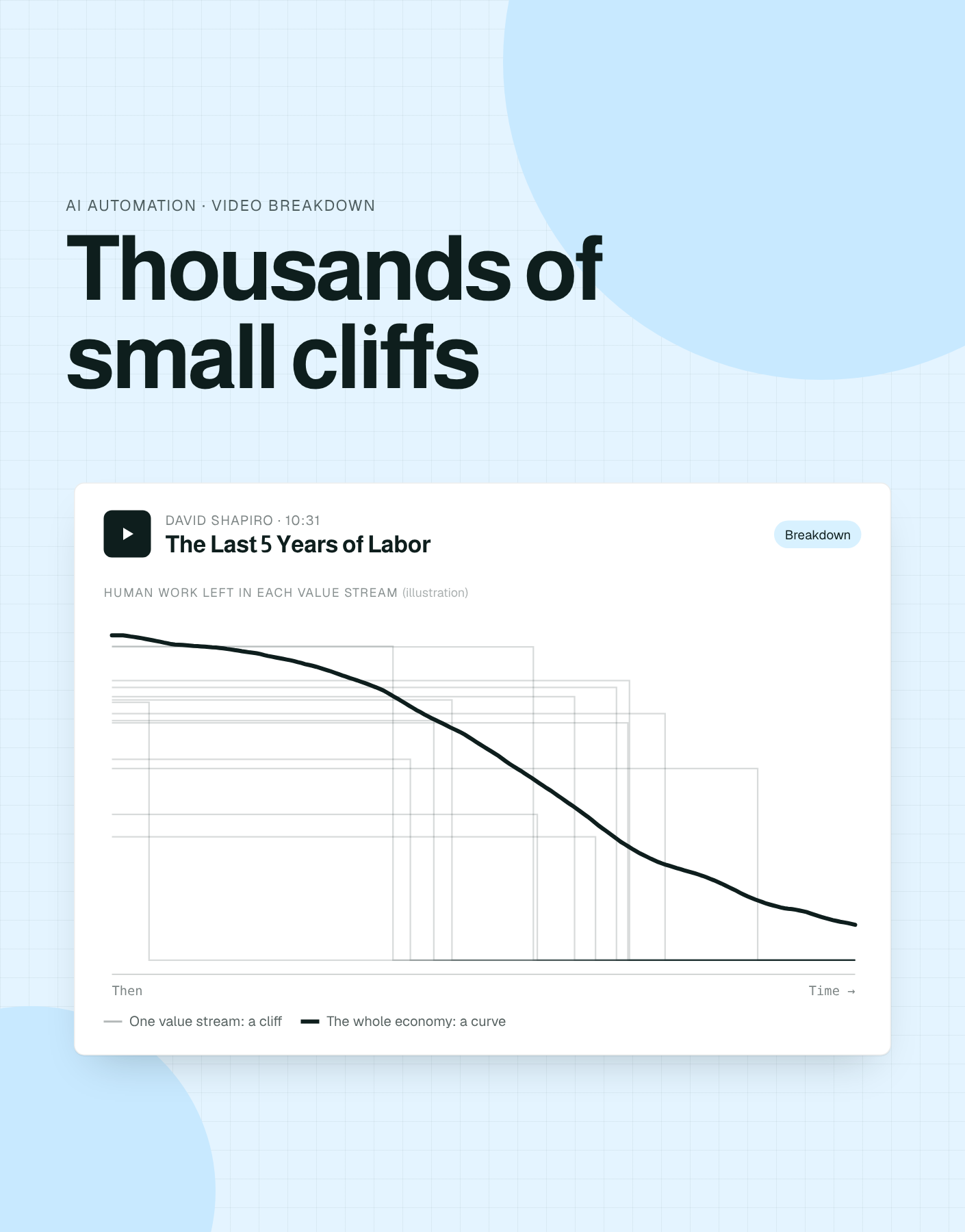
Here's Shapiro's revised thesis. The automation cliff is real, but it isn't one cliff. There are thousands of them, one for every value stream, and each goes over at a different time. (7:57)
He notes that economists who study technology have known this for decades. An invention often arrives as a single jump, but its spread through an economy is continuous and slow. Inside each value stream, it's a cliff. Across the whole economy, all of those cliffs add up to a smooth curve.
That explains the argument you see every month when the jobs report comes out. People look at the national numbers, see a gentle curve, and conclude nothing is happening. But a smooth aggregate is exactly what thousands of sharp, staggered drops look like from far away. As he puts it, the cliff happening one value stream at a time doesn't mean it isn't happening.
The jobs that never get posted
Most of these cliffs don't show up as layoffs at all. They show up as jobs that never get posted. He cites the Federal Reserve's report from this month: firms in five of its 12 districts said they had cut staff through attrition or delayed hiring after investing in AI. (8:28)
This matches what I see. When a client's order intake or invoicing stream flips, nobody gets walked out. The next person who quits just doesn't get replaced, and the req for the extra hire they were planning never opens.
Young workers go first
Which leads to who absorbs it. Researchers at Stanford looked at workers aged 22 to 25 in the jobs most exposed to AI. Since late 2022, employment for those young workers has fallen by 11%. Over the same period, employment for young workers in the least exposed jobs grew by about 10%. (8:57)
That makes sense through the value stream lens. Entry-level roles are the most task-shaped work in a company, so they map most cleanly onto a single stream. And if the savings show up as hires you don't make, the people you don't hire are the ones who were about to start.
Post-labor economics, and why he keeps talking about ownership
The last section ties it back to his larger project. Shapiro defines post-labor economics as a paradigm where human labor no longer acts as a binding constraint on economic activity or throughput. Every automation cliff is one more place where that's already true. (9:18)
When a value stream goes over its cliff, the work still gets done, often faster and cheaper. But the wages that used to flow from that work don't come back. That's why he keeps coming back to ownership. If your income comes only from your labor, every cliff takes a piece of it away. If you also own a stake in the machines, every cliff pays something back.
He closes with the answer to the original comment. There won't be a single day when the whole economy goes over the edge. It happens one queue, one department and one value stream at a time, and it has already started. He still believes in the automation cliff. He just thinks there are a lot more of them than he realized. (10:06)
Where I agree, and where I'd push back
Agree: the value stream is the right unit
This is exactly how automation lands inside a real company. Take Happy Endings, the London ice cream distributor we built for. Their email agent, Ophelia, reads incoming order emails and turns them into orders the team approves. Once it could reliably handle one order email, it handled all of them. That stream flipped in one go. The kitchen, the deliveries and the customer relationships still run on people, because those are different streams.
Push back: "perfect" isn't the bar a business actually needs
Shapiro frames the cliff as arriving once a stream hits enough nines. In practice, most streams don't need 99.9% to flip. They need to beat the current human error rate, plus a cheap way to catch the misses. That's why Ophelia's orders go to a person for approval: the AI does the 95%, and a human spends seconds on the last 5% instead of minutes on all of it. A good review step lets a stream go over its cliff well before the AI is perfect, and it's the same move Goldman made with its prospectuses.
Push back: physical work moves on a different clock
A lot of the companies we work with do field services, distribution and light manufacturing. Several commenters under the video make the same point I would: the cleaner the example, the more likely it's software or a call center. In physical businesses the cliffs hit the back office first (quoting, dispatch, scheduling, invoicing, collections), not the truck or the line. Those back-office streams are still a big share of the cost base, which is why they're where we start.
Push back: read the data with care
The information-sector decline has several causes, and he says so. Layoff attributions are self-reported in both directions: some companies blame AI for cuts they'd have made anyway, and others won't mention AI at all. I'd put more weight on the quieter signals, hiring that never happens and the young-worker numbers, than on layoff headlines.
What to do with this if you own or run a business
If Shapiro is right, and I think he mostly is, the useful question isn't whether AI will change your industry. It's which of your value streams are close to their cliff, and whether you'll be the one who pushes them over or the one a competitor does it to. Here's how I'd act on the video:
- Map value streams, not job titles. Write down what work actually does for the business (every inbound lead answered in five minutes, every invoice out the same day, every order entered without errors) and who touches each one. Our Systems Audit checklist is this exercise, written down.
- Start where the output is easy to check. Streams with a clear right answer (data entry, order intake, reconciliations, first-draft documents) march through their nines fastest.
- Budget for the nines. Run new automation in shadow mode or behind a human approval step, track the error rate, and only turn up the volume as the nines arrive. The first demo is the first nine, not the finish line.
- Fail small. Knight Capital is the reminder. Put rate limits, caps and a kill switch on anything that acts on its own, and roll it out so a bug touches ten records, not ten thousand.
- Keep people where trust is the product. Klarna ended up calling human support the VIP treatment. Decide on purpose where your customers should always reach a person, and protect it.
- Plan for the hires you won't make. The savings usually show up as attrition and roles you don't backfill, not layoffs. Be straight with your team about it, and move your best people into the last 5% where the value now sits.
- Think about who owns the upside. If you own the business, every cliff pays you. Shapiro's ownership point applies inside a company too, and profit sharing or equity is one way to make sure the people who help automate a stream share in what it pays back.
If you're a PE operating partner, the same list works across a portfolio. The value streams repeat from company to company (lead response, order-to-cash, scheduling, reporting), so the first cliff you push one company over is usually the template for the next. More on that in our technology playbook for portfolio companies.
Chapter guide
Every section of the video, with links that jump straight to that moment on YouTube.
| Time | What's covered |
|---|---|
| 0:02 | The question: does he still believe in the automation cliff? |
| 0:19 | The original forecast: Labor Zero and The Last 7 Years of Human Work |
| 0:35 | Why automation arrives as a cliff: Terraform and Amazon |
| 1:23 | The rule of thumb: perfect automation is arbitrarily scalable |
| 1:38 | Office work: the DWP pension backlog and Airbnb's test files |
| 2:11 | What he got wrong: one cliff vs. many |
| 2:26 | Workflows vs. value streams |
| 3:12 | Cliffs in action: Klarna, Salesforce, Duolingo, Goldman Sachs |
| 4:31 | When the cliff doesn't hold: Commonwealth Bank and Klarna |
| 5:02 | The catch: AI isn't deterministic, and the march of nines |
| 5:35 | Failure at scale: Knight Capital |
| 5:59 | The job-market numbers: information sector, call centers, programmers |
| 7:23 | AI as the leading stated reason for job cuts, and AI washing |
| 7:57 | The updated view: thousands of cliffs, one smooth curve |
| 8:28 | Why it looks like nothing is happening: jobs that never get posted |
| 8:57 | Young workers are hit first |
| 9:18 | Post-labor economics and ownership |
| 10:06 | The answer: still yes, just more cliffs |
Frequently asked questions
What is the automation cliff?
It's David Shapiro's term for the way automation replaces work: not gradually, but all at once. While an automation is being built it does nothing, and once it works it takes over the whole volume of a task. In The Last 5 Years of Labor he updates the idea: there isn't one economy-wide cliff, but thousands of them, one per value stream, each going over at a different time.
What's the difference between a workflow and a value stream?
A workflow is how the people doing the work see it, like the queue of tickets on a support agent's screen. A value stream is what that work does for the business, like making sure every customer gets an answer. Automation takes over value streams, which is why it rarely replaces a whole job at once.
What is post-labor economics?
Shapiro defines it as a paradigm where human labor no longer acts as a binding constraint on economic activity or throughput. His argument is that each automation cliff makes that true for one more value stream, so income tied only to wages shrinks, and owning a stake in the machines becomes more important.
Is AI really causing layoffs, or is it AI washing?
Both. US employers named AI as the reason for 120,136 job cuts from January to September 2026, the leading stated reason this year. But Sam Altman and others have pointed out that some companies blame AI for cuts they'd have made anyway. The quieter signals, like hiring that never happens and falling employment for 22-to-25-year-olds in AI-exposed jobs, are harder to spin.
How should a business decide what to automate first?
Map your value streams, then start with the ones where the output is easy to check and mistakes are cheap to catch, like order intake, data entry or first-draft documents. Run the automation behind a human review step until the error rate is where you need it, and keep people on the parts of the business where trust is the product.
Sources
- The Last 5 Years of Labor, David Shapiro, YouTube
- Labor Zero (pre-order), Amazon
- Klarna's AI bot is doing the work of 700 employees, Euronews
- Airbnb uses LLMs to accelerate a large-scale test migration, InfoQ
- Australia's biggest bank reverses plan to replace jobs with AI, Bloomberg
- SEC charges Knight Capital with violations of market access rule, U.S. Securities and Exchange Commission
- Canaries in the Coal Mine (August 2026 update), Stanford Digital Economy Lab
- Challenger Report: March cuts rise, AI leads reasons, Challenger, Gray & Christmas

Isaac Harmon · Founder, Harmon Digital
Isaac runs Harmon Digital, which builds custom software and AI employees for private equity portfolio companies, and built Unstack, the platform behind those builds. Finance degree from Mizzou; seven businesses started before 21, so he has been on the operator's side of messy systems.